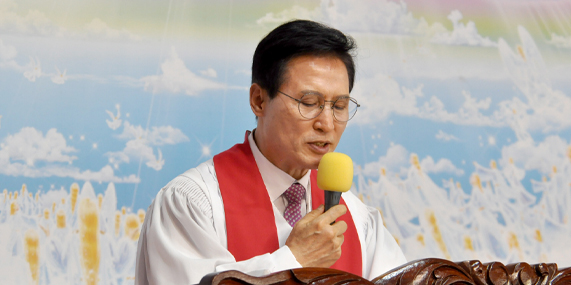
Path of Hope, River of Prosperity
Bible passage: Isaiah 43:15-19
“15. I am the LORD, your Holy One, Israel's Creator, your King." 16. This is what the LORD says-- he who made a way through the sea, a path through the mighty waters, 17. who drew out the chariots and horses, the army and reinforcements together, and they lay there, never to rise again, extinguished, snuffed out like a wick: 18. "Forget the former things; do not dwell on the past. 19. See, I am doing a new thing! Now it springs up; do you not perceive it? I am making a way in the desert and streams in the wasteland. ”
I once saw an article on the topic, ‘How can students study well?’
In that article, the term ‘metacognition’ was introduced, and these days, when you look at books or YouTube, the term ‘metacognitive learning method, metacognitive ability’ often appears. ‘Metacognition’ is said to be ‘the ability to accurately distinguish between what you know and what you do not know.’ In a word, it refers to the ability to accurately understand oneself.
A broadcasting station production team conducted an experiment regarding ‘metacognition.’ They conducted an experiment by creating two groups: students who were very good at studying and students who ranked first or second in their school were grouped into this group, and the other group was made up of average students. It was an experiment to find out what makes students who are exceptionally good at studying different from ordinary students through various tests such as memory tests and memorization tests.
Analyzing the results of the experiment, surprisingly, there was no significant difference in memory or memorization between the good and poor groups. So, what is the difference between the top group and the bottom group, and why are the top groups so good at studying? The explanation of the experimental results shows that there is a difference in ‘metacognitive’ ability rather than something else. According to a psychology professor's analysis, the difference between these two groups is not a difference in memory or memorization, but a 'difference in perspective' in terms of 'how accurately one can see oneself.' Students with high metacognitive ability know exactly what they know and what they do not know, so they create learning strategies and study methods that systematically maximize their strengths and complement and minimize their weaknesses. Because you study hard, you will get much better grades compared to students who just study. Metacognitive ability is not just necessary for studying well; it can be seen as playing a very important role in all aspects of people's lives.
If we look at the Israelites in today's scripture from this perspective, they are a people with very low metacognitive abilities. When the prophet Isaiah wrote today's scripture, northern Israel had already been destroyed by Assyria, and southern Judah was on the verge of being destroyed by Babylon. In this crisis situation, God gives a word to the Israelites through the prophet Isaiah, and that is today's scripture. Verse 19 says, “See, I am doing a new thing! Now it springs up; do you not perceive it? I am making a way in the wilderness and rivers in the desert. ” Metacognitive ability is the ability to understand the pros and cons of reality and deal with the future, so Isaiah, who has a high metacognitive index, receives the word of God and informs in advance what will happen in the future of the Jewish people, and even after Israel's destruction, it presents a path to recovery. Because of your sins, you will experience the miserable history of being taken to Babylon, but that is not the end.
God will not leave you alone. It delivers a message of courage and hope that God will definitely do something new before you and create a path of hope and a river of prosperity. To lead a good religious life, you must have high ‘metacognition’. You need to understand well what you are doing well or not so well, and continue to improve the things you are good at, and put more effort into improving the things you are not good at. I hope that all of the believers who attended today’s service, especially the women’s mission members who are attending the devotional service, will raise their ‘metacognition index’ and become more blessed and prosperous believers and women’s mission members. I am going to preach for this devotional service while thinking of four words that come to mind from the scripture.
1. The first word that comes to mind is ‘new work.’ Verse 16 says, “He who made a way through the sea, a path through the mighty waters, ” and as an example, verse 17 talks about God dividing the Red Sea and making a way through the sea at the time of the Exodus. At the same time, in verse 18, He said, “Forget the former things. ” What is the reason why God told us not to remember the amazing miracle of opening the way by parting the Red Sea during the Exodus? The answer is found in verse 19, and it is to do something new.
So, what is this new thing? It will be a bigger and more tremendous event than the ancient work of dividing the Red Sea to create a path. The new thing is shown in verse 19 which says, “Do you not know that I am making a way in the wilderness and rivers in the desert?” The new thing that God will do is to make a way in the wilderness and a river in the desert. During the Exodus, God provided only a path to the sea, but when they returned from captivity in Babylon, He would provide not only a path but also a river. When the Israelites left Egypt, God provided a way for them to cross the Red Sea and enter the land of Canaan, but they left God and became corrupted by idolatry.
Northern Israel had already been destroyed by Assyria, and southern Judah was on the verge of being destroyed by Babylon. If God were to provide only a way this time, the Israelites would be anxious, fearing that the same results as before would be repeated. So, God said that this time, unlike in the past, He would make a way in the wilderness and a river in the desert. The wilderness speaks of despair, and the path speaks of new hope. The desert symbolizes poverty and the river symbolizes prosperity. Looking at the physical aspect, the commonality of the world's four major civilizations, which are the origins of today's world civilization, is that they all prospered along rivers.
The Mesopotamian civilization prospered along the Tigris and Euphrates rivers, the Egyptian civilization prospered starting from the Nile River basin, the Indian civilization prospered along the Indus River, and the Chinese civilization prospered starting from the Yellow River basin. So, God is going to do something new that will create a path of hope and a river of prosperity. Ezekiel 47:9 explains the river as follows: “Swarms of living creatures will live wherever the river flows. There will be large numbers of fish, because this water flows there and makes the salt water fresh; so where the river flows everything will live.” When the Israelites were leaving Egypt, in a state of despair with the Egyptian army pursuing them behind them and the Red Sea blocking them in front, God created a way under the sea, leading them to a path of new hope. However, because the river of prosperity was not provided, Israel did not prosper and was impoverished and then destroyed.
However, this time, God would do something new: not only would He provide a path of hope to overcome despair, but He would also give them the blessings to overcome poverty and prosper. In John 14:6, Jesus mentioned the way by saying, “I am the way and the truth and the life. No one comes to the Father except through me.” Jesus is the way to heaven. He who believes in Jesus can be saved. And in John 7:38-39, Jesus, who is the way, said, “Whoever believes in Me, as Scripture has said, rivers of living water will flow from within them,” and that the river refers to the Holy Spirit. Therefore, God doing a new thing means not only believing in Jesus and being saved and going to heaven, but also allowing us to receive the blessing of prosperity while living on this earth through the help of the Holy Spirit who is with us.
I hope that not only all the members of the Women's Mission who are holding their devotional service today, but also all the members of Manmin Church who attended today's service, will not only believe in Jesus and be saved and go to heaven, but also win to their heart's content and be greatly blessed through the fiery work of the Holy Spirit on this earth. However, there is one thing here that may be considered strange. If He is going to do something new, couldn’t He from the beginning not allow it to be destroyed? Rather, couldn’t He just make a way and a river again after it is completely destroyed?
There is a Korean proverb that says, ‘Give a person sickness and give a medicine.’ This refers to the duplicity of treating someone badly or putting them in trouble and then helping them as if they were being kind. But it is impossible for God to do something like this. God wants to correct the faith of people who have fallen into despair due to wrong beliefs and a life of disobedience, and have them be reborn as good people, so that they can enjoy greater prosperity and blessings than before. There is a term called ‘creative destruction’. It refers to bringing about change by destroying the old and creating something new.
To build a new house, the old house must be demolished, and this can also be expressed as ‘creative destruction.’ There is a famous fable called ‘The Kite’s Creative Destruction’. 6 Kites are generally known to be the longest-living birds. A kite can enjoy a lifespan of about 70 years, but to live this long, a very painful and important decision must be made when the kite turns 40 years old. It is said that when a kite reaches the age of about 40, its claws deteriorate and it is no longer able to effectively catch its prey. It is said that the beak grows long and curves until it touches the chest, and the feathers grow dark and thick, making it very heavy, making it difficult to fly into the sky.
At this point, the kite has only two choices. The question is whether to wait until death or go through a very painful rehabilitation process that will take about half a year. A kite that chooses the path of rehabilitation first flies high near the top of the mountain, builds a nest there, stays there, and begins painful training. First, it pecks at the rock with its beak, causing the beak to break and fall out. Then, a new beak gradually sprouts. Then, it pulls out the claws one by one with its newly sprouted beak. And when new claws sprout, this time they pull out the wing feathers one by one.
In this way, after about half a year, the kite sprouts new feathers and transforms into a completely new appearance. And then they soar powerfully into the sky again and enjoy another 30 years of life. This is the process by which a kite undergoes a completely new transformation through a process of creative destruction. God intends to completely correct the erroneous beliefs and false images of the Israelites and transform them into a completely new image so that they can enjoy blessings. 2 Corinthians 5:17 says, “Therefore if anyone is in Christ, he is a new creature; the old things passed away; behold, new things have come.” Even though you say you are saved, do you still have old things from before you were saved? 7 Colossians 3:9 tells us, “Do not lie to each other, since you have taken off your old self with its practices. ” We, the beloved members of Manmin Church and the members of the Women's Mission who hold this devotional service, pray that through God's power to do new things through creative destruction, not only will there be a path of hope for you, but a river of prosperity will overflow in your future.
2. The second word that comes to mind in today’s scripture is grace. It is entirely through the grace of God that a path of hope is created in the wilderness and a river of prosperity flows in a devastated place like a desert. The words of the scripture in verse 18 right before verse 19 that convey this message of hope are very impressive. Verse 18 says, “Forget the former things; do not dwell on the past.” The flow of God’s teachings to the Israelites is ‘Remember and do not forget the things of old, ’ as indicated in the following verses: Deuteronomy 5:15 says, “Remember that you were slaves in Egypt and that the LORD your God brought you out of there with a mighty hand and an outstretched arm.
Therefore the LORD your God has commanded you to observe the Sabbath day.” Deuteronomy 32:7, “Remember the days of old; consider the generations long past. Ask your father and he will tell you, your elders, and they will explain to you.” Isaiah 46:9 says, “Remember the former things, those of long ago; I am God, and there is no other; I am God, and there is none like Me.” It all emphasizes remembering the past and the things that were before. However, today’s scripture specifically says, “Do not remember the former things, do not even think about them.” The word ‘do not remember’ or ‘forget’ here does not mean not to remember the things that God has done.
God said, ‘Do not remember,’ in the sense that we should not think of the Israelites as if they were the subject, when the subject who created it was God. For example, thinking about the parting of the Red Sea in the past, “Moses and Israel were great. They defeated Pharaoh and his soldiers in Egypt and crossed the Red Sea.” This means that we should not be arrogant by thinking in this way and exposing ourselves by exalting ourselves by saying, ‘We did it, ’ or ‘I did it.’ This means that everything was done by God, not by Moses or because the Israelites were so great that they were able to cross the Red Sea. In a word, it means to remember that everything was the grace of God. Christians must do a good job of organizing their memories of the past.
As to what perspective those who believe in Jesus should look at the past, the Apostle Paul summarized this very well in 1 Corinthians. 1 Corinthians 15:10 says “But by the grace of God I am what I am, and His grace to me was not without effect. No, I worked harder than all of them - yet not I, but the grace of God that was with me.” All of the past times of Christians can be summarized with the word ‘grace.’ If we were to sum up all of our lives up to this point in one word, we could say that it was God’s grace. You must not forget; God has done tremendous work for our Manmin Church during its 23rd anniversary; And to sum it up in one word, it is GRACE.
Just as God said in Jeremiah 33:2, “This is what the LORD says, He who made the earth, the LORD who formed it and established it - the LORD is His name”, it is God who did it and achieved it. I went to Mombasa about a month ago for the MIS training. But it is said that something as follows happened at that time. A young man living near a church in Mombasa where MIS training was to be conducted felt bad when he heard that a foreigner was coming to lead the meeting. The foreigner here refers to me. I guess he thought that foreigners would have some money. Actually, I didn't have any money. Anyway, he prepared long knives with the intention of stealing the money, called about 20 other young men of the same age, and plotted to steal the money. Even though this dangerous conspiracy was being hatched, neither the mission team, including myself, nor the Mombasa church that hosted MIS knew about it.
However, someone in the neighborhood, whom we didn't even know, found out about this and reported it to the police without telling us. We, who knew nothing, had successfully completed all of our MIS training and were giving glory to God by sharing happy fellowship with each other. It is said that at that time, these evil young men were approaching the church with long knives to threaten us and rob us of our money. However, it is said that at that moment, the police who had received the report in advance and were in hiding arrested them all in a desperate moment. How did I find out about this? My mission team and I returned to Nairobi, thankful to God for successfully completing the MIS training without knowing anything. However, about 10 days later, I received a call from the pastor in charge of MIS in the Mombasa region and she explained that this had happened.
In order for these evil young people to be released from police custody, they would have to pay a lot of fines, but since their parents do not have the means, they thought that the children could be released only with the help of the pastor of the church that hosted MIS, and the pastor of that church I came to see him and told him the whole story. The pastor is now a pastor of our Manmin branch church, and the pastor did not know this too, but he found out about it when the parents of the young people told him about it. So, it was only then that I learned that something incredibly dangerous had happened. Who protected us from this danger?
The mission team knew nothing about it, but God knows everything, so He took control of the hearts of people in the neighborhood whom we had never met before and made them report it to the police. As a result, the mission team and I were able to return safely without any problems. Everything is God's grace. In the Psalms, David said that even the smallest things, such as waking up after a night of sleep, are taken care of by God. Psalm 3:5 says, “I lie down and sleep; I wake again, because the Lord sustains me.” Psalm 4:8 says, “In peace I will lie down and sleep, for You alone, LORD, make me dwell in safety.” It is all thanks to God's grace that you slept safely and peacefully last night and came out today in good health to attend the Sunday service and this devotional service. Isn't it?
Think about it. Last night, while you were sleeping without knowing anything, didn't you know that thieves were wandering around the house trying to steal, and then said, “This house won't work, let's go somewhere else, ” and went somewhere else? This is all God’s grace. The God of grace who has protected Manmin's flock and supported Manmin Church until now will continue to bless our Manmin Church, our local sanctuaries, and the members of the Women's Mission who are holding their devotional service today. He will make a way in the wilderness and make a river in the desert. If you believe that God will give it to you, let's say 'Amen'. Let us say ‘Amen’ louder.
3. The third word that can be thought of through the scripture is ‘expectation.’ The word that God will do a new thing means that although we are currently in a desperate situation as we are taken captive to Babylon, we expect that in the future, a path of hope will be created to return from Babylon to Israel and a river of prosperity will flow in the devastated land. It is to be done. It means having expectations for a prosperous future that goes beyond the reality of despair. The reason why God, who told us to remember the old things, tells us not to remember the old things in today's scripture is that He will do new things for you in the future, so you should expect new things to happen. During the Exodus, the Red Sea was split to create only a path through the sea, but this time, God tells us to be hopeful because not only a path but also a river will be created. If you look at verse 18 again, elsewhere it says to remember the things of old, but here it says not to remember, but this is a method of emphasis. What kind of emphasis is this? You will do greater things in your future than the things of the past or that were before, so please do not be discouraged or despair because of the things of the past, but look forward to the prosperity that will come in the future. This means that you should not be obsessed with the past because you must focus your whole heart with anticipation of what God will accomplish. How do you feel when you think about the future? Do you think it's unclear?
Are you feeling anxious? Are you at a loss? When Christians think about the future, they must be filled with anticipation. It can be summarized as ‘the future of Christians is an expectation.’ Instead of being a past-oriented person, you should be a future-oriented person. Verse 19 uses the word “Behold” means “expect.” Before a movie is screened, there is an advertisement that is sent out to attract the attention of the audience and mobilize a large number of viewers. Do you remember ‘Look forward to the release date’? Now God is speaking. “Look forward to its release soon.” The title of the movie is ‘Path of Hope, River of Prosperity.’ There's something I say sometimes. ‘The best time of my life is yet to come. The best thing in my life is yet to come.’
If I were a teenager, of course it would not have come, but I am now almost 70, and it is God's blessing and the Lord's grace that allows me to say that the best time in my life has not yet come. If I were in Korea, I would not be able to make this confession because I would have to leave the church at retirement age, but now that I have come to Kenya, there is so much to do and our believers have so much passion and love that when I look at the church, I feel excited about the future. As I was filled up, I naturally said, 'The best time of my life has not yet come.'
The saying goes, ‘The best thing in my life is yet to come.’ Whenever we come before God, we must always have a sense of anticipation. I believe that the believers who came to today’s service, especially the women’s mission members who are holding their devotional service, attended the service with expectations of the grace and blessings that God will give them. If you worship with this kind of expectation, you can truly worship in spirit and in truth and receive grace and blessings as expected. If you come to church because things are going well, you can just give thanks. If you are going through a dark tunnel in life, believe that God will give you a path of hope after refining you. If you pass this test well, you will be in a river of prosperity later. You can look forward to this flowing blessing. Would God leave you like this? He is the God of love who let His Only Begotten Son Jesus to be crucified on the cross instead of you and saved you, so would He just watch you in a difficult situation?
I believe that the God of love will do something new for you who are trapped in the dark cave, make a way through the cave, create a tunnel, and lead you out of the tunnel safely to a world of peace where rivers of prosperity flow. Joseph in the Book of Genesis was falsely accused and locked up in a cave called prison. However, God, who makes a way, made a way into the prison, and the cave called the prison became a tunnel. A cave is a place with no way out, but a tunnel is a place with a way out. God is the One who makes a way into a cave that is blocked on all sides and turns the cave into a tunnel. Joseph safely escapes the cave of prison through the path created by God, and at the age of 30, he becomes the prime minister of Egypt, the most powerful nation at that time, and is blessed with the river of prosperity. Daniel, who was the prime minister of Babylon, was also imprisoned in the Lion's Cave for praying to God, but God sent an angel to make a way, and the Lion's Cave was transformed into a tunnel, and Daniel, who came out alive along the tunnel, gave greater glory than before to God. Daniel experienced the river of prosperity.
Dear believers, members of the Women’s Mission who hold your devotional service, are there any of you who are trapped in a dark cave and unable to do this or that? We hope that the God who makes a way in the wilderness and a river in the desert, and the God who turns caves into tunnels, will make a path of hope and a river of prosperity. So, we must not lose hope. When you came to church for worship, did you come with expectations? When you come to church on Sunday, there are some necessities you must bring, right? You must bring a Bible, right? Also, since it is said not to go to God’s house empty-handed, you must also bring an offering, right? What else should you pack? It's a feeling of anticipation. You must come with expectations.
For example, you may have expectation like, “I have been suffering for a week because I have been feeling frustrated and my life hasn't been resolved, so what word will God give me today to give me a way?” “Every Sunday when I come to church, I wonder, what word will God give me today?” Did you come out today with a longing heart and expectation that by holding on to the word and praying, you will find the way and move to the river of prosperity? Such people already have a different attitude in listening to the Word. They have an upright sitting posture and their eyes are wide open. However, a person without expectations would simply lean back comfortably on the back of his chair, close his eyes, and wander around in an imaginary world or dreamland. At this time, I hope you will change your thoughts to expectations about God, such as, “I am not the kind of person who will remain trapped in a dark cave like this.” I hope that you will be filled with anticipation by making the decision, “I will meet God who makes the way, get out of the tunnel of despair, and reach the river of prosperity.”
4. The last word to think about is participation. It is important to have expectations about God who makes paths and rivers flow, but we must go one step further and participate in God's work of making paths and rivers. In Chapter 6 of the Gospel of John, Jesus provided food for 5,000 men and about 10,000 women and children with ‘5 loaves of bread and 2 fish’. And He made the river of blessings overflow so that even after eating to the full, there were still 12 baskets left. But how and why did God create this amazing path and river? When the Lord said, “You give them something to eat,” how could the disciples give food to so many people?
As the disciples went everywhere, they found a lunch box packed by a child, and Jesus told them to bring it. Why did Jesus ask the child to bring the packed lunch? Did Jesus try to take away the child's lunch? No. He wanted to make that small lunch box, 5 bowls and 2 fish, into ingredients for a miracle, to create a way for 10,000 people to eat, and for a river of blessings to flow. Jesus is the Son of God and can create something from nothing. In that case, it would have been possible for Him to turn the many stones on the mountain into bread or say, “Be full even without eating,” but instead He did a miracle with that child’s lunch box. Why did He do like this? God is pleased that we participate in His work. There are two reasons why God wants us to participate in His work. First, it is necessary to fulfill the justice that can bring about a sign, and second, it is to give blessings to those who participate in God's work. Knowing that he was a child with a heart enough to give his own lunch box to the Lord, the Lord wanted to bless the child. If he is a child with a bad heart, if he is hungry, will he give the lunch he brought to an adult if he asks for it? Most kids say, “I don’t like it. I want to eat it. I’m hungry too.” and won’t serve or give it.
Although the young child is not recorded in the Bible, he would have been blessed not to starve throughout his life and would have received many blessings while leading a good religious life. When the child’s lunch box was given to the Lord, a path was created. The river overflowed and they ate plenty, and there were still 12 baskets left. The river of blessings overflowed. A river of joy overflowed. The river of grace overflowed. When you participate in God's ministry, answers will come and blessings will come to you. Reverend Mi-young Lee, who came last time, said the following to me. “It seems that God sent the pastor to the Nairobi Manmin Church in Kenya to help him go to New Jerusalem. In Korea, once you reach retirement age, you no longer have the opportunity to do God's work, but since overseas missionaries have no retirement age, the reason you were sent to Nairobi Manmin Church was to continue to participate in God's work, carry out more missions, and be faithful until death.”
I also believe that this contains God’s will to help us go to New Jerusalem. Members of the Women's Mission who are holding their devotional service today should naturally expect that the road of hope will open and the river of blessing will overflow in the future, but we hope that they will go one step further and participate in God's work of opening the road and making the river flow. There is a term called priming water. When I was young, and lived in Seoul, Korea, there was tap water, but the water situation was not good, so I remember using a pump to pump groundwater. However, the pump did not automatically raise water using a motor like these days, but was a manual pump that raised water by vigorously moving the handle attached to the pump. However, when I woke up in the morning and pump to wash my face, there are many times when I only heard a ‘clunk, clunk, clunk’ sound as the handle moved, but no water came out. Water is pulled up using the difference in air pressure, but if the cylinder is empty, the pressure difference does not occur and the water cannot be pulled up.
Then my mother who was watching said, “Son! Scoop a bucket of water and put it in the cylinder.” As my mother said, if you put a bucket of water into the cylinder and pump it, the water comes out smoothly. In order for the pump to work well, the first bucket of water poured is called ‘priming water’. The priming water is ‘a small bucket of water’, but as long as you pump well, you can use as much groundwater as you want. Participating in God’s work is like this priming water. One child's small lunch box became the priming water and overflowed the river of blessings, feeding more than 10,000 people. An abundant life is not because you are abundant now. Life is not abundant because you have a lot now, but if you live with overwhelming emotions and expectations, your life will be abundant. 18 It is participating in God’s work of making a way in the wilderness and a river in the desert.
Our church is a church with a lot of work to do. This is because we need to prepare for Senior Pastor Dr. Soojin Lee’s continent-wide crusade by carrying out mission works in Africa. These days, the Men's Mission members are leading the way and are participating in God's work by setting an example in the construction of our washrooms expansion and renovation. Hundreds of blocks were donated and stacked in the church yard to be used for washroom expansion and renovation. Watching this, I was reminded of the scene where Moses was trying to build the tabernacle and the people were bringing so much material that it was overflowing, so he told them to stop bringing more. Exodus 36:5-7 says, “and they said to Moses, “The people are bringing more than enough for doing the work the Lord commanded to be done.” Then Moses gave an order and they sent this word throughout the camp: “No man or woman is to make anything else as an offering for the sanctuary.”
And so, the people were restrained from bringing more, because what they already had was more than enough to do all the work.”” When King David also wanted to build the temple, he collected a lot of building materials, and there was an abundance of materials such as gold, silver, brass, and iron. 1 Chronicles 22:14 says, “I have taken great pains to provide for the temple of the LORD a hundred thousand talents of gold, a million talents of silver, quantities of bronze and iron too great to be weighed, and wood and stone. And you may add to them. ” 1 Chronicles 22:16 says, “in gold and silver, bronze and iron - craftsmen beyond number. Now begin the work, and the LORD be with you.” Currently, our church is building a ‘the late Bishop Cheong’s Memorial Library.’ Once this is completed, ‘toilet expansion and renovation work’ will have to begin. Also, we are planning to carry out the ‘Ongata Rongai Local Sanctuary floor construction’. And once this is completed, we are planning to begin construction of the main sanctuary.
The cost of ‘Ongata Rongai local sanctuary floor construction’ has been secured by a deacon from our headquarter church in Seoul Korea who has already donated the cost of the construction. It is not something we will be happy about just because our Korean church sends us support funds. You will receive blessings only if you participate in God's work and the church's work. Like the child who offered five loaves and two fish, and like the widow of Zarephath who offered the last piece of bread to the prophet Elijah, believers who participate in God's work are blessed. As much as your passionate love for the Lord and your passionate desire for the New Jerusalem, that warmth is also transmitted to your hands and feet, and you participate in God's work for evangelism and service, church revival, and African missions. I hope this happens. I know that the Women's Mission Group, which holds their devotional service today, is participating well in God's work by providing exemplary service and service to God's kingdom and church. I hope that the entire Women's Mission Group will become one, love and serve, become a model organization for the church, serve large and small groups in the church, and participate more in God's work to play a leading role in the revival of the church.
CONCLUSION I like to see the lives of animals in national parks in various African countries, such as the Masai Mara. As I prepared to preach and meditate on today's sermon, the world of African animals came to mind. During the dry season, animals die because there is no water in the plains. As the river dries up, it is difficult for crocodiles to survive and even hippos to survive. Animals and birds do not have water, so they migrate in search of water. Then, when the rainy season comes, water flows in, a road is created in the wilderness, and a river appears and overflows in a dry, desert-like plain. Animals return, grass grows, trees grow, flowers bloom, fruits are borne, rivers are filled with fish, and all the plains are filled with fish. The animals become full of life.
In today’s scripture, God is saying that He will do this to us as well. This means that a path of hope will be created in the wilderness of despair, and a new work will be done in the devastated desert, overflowing with rivers of prosperity. To all the believers who attended today’s service, and especially to the members of the Women’s Mission Group who are holding their devotional service today!
We expect that God, who has led us by grace so far, will do new things in the future, and we will participate in God's work of making roads and rivers, so that we can help our families, businesses, children, and the future of our church. I pray in the name of the Lord that a path of hope and a history overflowing with rivers of prosperity will be created. - END -